What’s new in Data Analytics

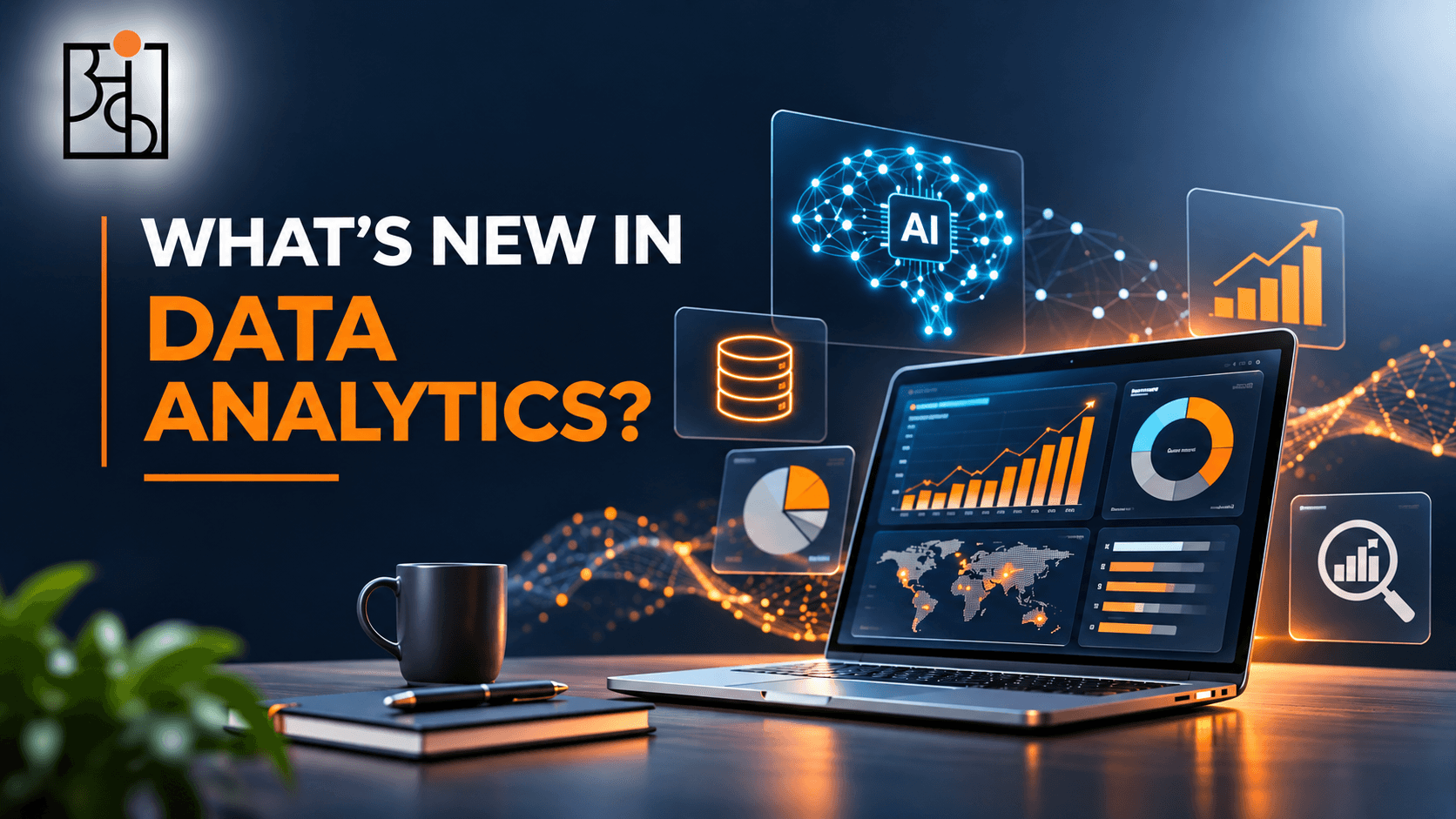
Every couple of years someone proclaims that data analytics has been revolutionised. Mostly it’s just rebranded, adding a chatbox to dashboards. However 2026 feels like it is a little different. Some of these changes have been implemented at the same time and mean that even if no one on your team is technically minded, the way your business makes decisions has changed. We’ve attempted to highlight what is actually changing and what is just a lot of noise based on where we are in early November 2026.
Table of Contents


Key takeaways
- AI is doing more investigative work.
- Only works well if your data is meaningful.
- Data quality and governance are now an issue for AI.
- Real time data is more important in certain areas and not at all in others.
- There is more consolidation of platforms and more data being analysed.
- In India, Privacy laws are becoming more of an engineering task.
- Critical thinking skills are still the most scarce.
1. From dashboards to agents
For the last 20 years or so analytics has been a case of creating a report, opening it, spotting something odd and asking a question. Agentic analytics is attempting to change this. It uses an AI agent to watch over your data. When it detects something has changed it will investigate further by making additional queries. It will then return a reason or suggestion. Rather than having to search for why sales dropped in one region you’ll have the agent investigating and telling you what it’s found.
This is seen as the story of the year for many analysts. Gartner have structured their 2026 data and analytics trends around three themes including agentic analytics, semantics at the core and consolidation of platforms. TDWI have predicted Agentic AI will be the year it moves from experimentation to practicality.
However, Gartner have also stated that by the end of 2027 over 40% of projects involving agentic AI will be cancelled due to increased costs, unclear business value and poor risk managment. Many projects will fail simply because the data isn’t ready for the machine to act on. The agent will still provide answers, however they will be confident but wrong.
We believe agents do exist and it’s worth trialling them on some low risk tasks. However, be cautious of anything labelled autonomous that can’t tell you how it got to an answer.
2. “Ask your data a question” is getting good
Asking an AI a question in plain language and getting a chart in return used to be a party trick. However, most major analytics platforms now provide this functionality and it is a really useful tool for quick investigations.
The issue is that the language model won’t know what your business means by revenue, active customers or margin. If you give it raw data it will not know which tables to join and what each column means. When tested on realistic company databases the accuracy falls far below what you would see in a shiny demo from a vendor.
The solution to this is…
3. Semantic layer – Not glamorous but probably most important.
A semantic layer is essentially a glossary. It defines what your business considers revenue, how active customers are measured and which table contains the answer. Any reports, dashboards or AI tools will use this definition.
This has received a lot of attention. Gartner have said that data leaders will need to create a universal semantic layer. A survey done by Futurum earlier this year showed that nearly six in ten organisations are investing additional budget into this. There is also an industry initiative to create a common language between tools called Open Semantic Interchange.
You don’t need any software to start this. If two teams within your company have different definitions of an active customer then an AI will happily give you an answer based on both. Simply writing down the definitions of your 10 most important metrics with an owner will provide most of the benefit.
4. Data quality and governance are an issue for AI
Previously one bad data point would ruin one report. Now it could be used by an agent to make dozens of decisions.
Governance has changed from a static set of rules to a dynamic process that tracks where numbers have come from (lineage), how data is being used and how models are behaving. Surveys of stalled AI pilots consistently show data quality as one of the main reasons they fail.
Fixes are the same as ever, but are now more critical. Make sure you have units in your field names, sensible ranges, one date format and an owner for all important fields. This is not new technology, but requires people to care about the data they are entering.
5. Real time data
Gartner have highlighted real time data as a trend for 2026. Agents need real time data. Batch processes that update overnight aren’t quick enough for some uses.
However, most businesses don’t need everything in real time. It can be expensive to implement. A good way to determine if you need real time data is to think about what decisions you would make differently if you had this information an hour sooner. Often fraud checks, stock levels, logistics and plant operations will have a good answer. However, a monthly sales review usually won’t.
6. Consolidation and non-spreadsheet data.
There are two less obvious trends.
There is more consolidation. More features are being combined into fewer, larger tools that include storage, reporting and AI. While this makes things easier it also means it will be harder to switch. Try and find out how easy it will be to move your data and definitions early.
Analytics is no longer limited to spreadsheets. Customer reviews, support chats, documents, images and call recordings can all now be summarised and searched. The best way to use this is to use it as a lead source. For example if there have been twice as many complaints about delivery in this region. You can then check this against the numbers. Synthetic data and privacy techniques will be mentioned more. These allow you to use data for testing and training without exposing people. Worth keeping an eye on, but are not needed for most small teams.
7. Privacy laws in India are becoming an engineering task.
If you work in India this is a trend with a deadline. The Digital Personal Data Protection Rules were notified in November 2025. Obligations will be rolled out over the course of around 18 months. The consent manager framework will become operational around 13th November 2026 (days away!) and full compliance will be required in mid-May 2027. The Data Protection Board can fine up to ₹250 crore per instance.
From an analytics perspective it’s a good idea to start with an inventory. Where is personal data stored (CRM, analytics tools, marketing tools, logs)? Why? What consent? Which vendors have access? Even if a vendor is doing the processing it is still your responsibility. Vendor contracts will also be important. This isn’t legal advice but it’s worth checking with a legal professional. However it’s cheap to start early.
Read More: How to Think Like a Data Analyst (Even If You’ve Never Touched a Spreadsheet
8. Critical thinking skills are becoming more scarce.
AI is very good at doing the basics. Creating initial queries, charts and summaries. It can’t decide what question to ask, notice that the answer doesn’t make sense with what you know about the business or explain findings to someone who needs to make a decision by Friday.
This means SQL and Excel skills are still important. Data fluency is becoming a skill across the whole company. Think With Data at Ankashram is based on this principle. Tools change every year but having the habit of questioning ‘compared to what?’ and ‘what am I missing?’ will be applicable to all tools.
Mostly Noise.
Fully autonomous analytics. Analysts have a term for this – Agent washing. Ask what decisions are actually being made and who is reviewing them.
Chatbox with unclear metrics. If no one can agree on what the numbers mean it will just cause confusion quicker.
Trying to use every new feature. Most teams will gain more from defining their metrics and ensuring clean data entry.
Buying AI without doing the basics. Most projects will be cancelled.
What to do.
- If you are running or working within a business.
- Define the definitions of your 10 most important metrics and who owns them.
- Ensure clean entry points for your most used data. Units, ranges, formats and owners.
- Identify one area where you can use AI for a small task and ensure it is reviewed. E.g. Summarising customer feedback or creating queries.
- Start an inventory of personal data.
- Teach people to question outputs.
- If you are developing your skills.
- Learn enough SQL and Excel to understand what the AI has provided.
- Practice with messy real data and complete full projects.
- Get good at explaining your findings in two plain sentences.
Overall
While there are many new terms the trends for 2026 are the same. AI is doing more of the work so data quality, clear definitions and critical thinking skills are becoming more important. Most likely those who will benefit most are those who have people who know how to question the outputs rather than the most tools.
This is the principle we focus on at Ankashram. Our workshops focus on building habits. If you’d like to talk through how we could help your team build these habits please get in touch.
Frequently Asked Questions
Q1.What is the biggest trend in data analytics?
AI agents are doing more investigative work. However, there is less glamourous work to ensure they are trustworthy. Having clear definitions, good data quality and governance. Most analysts will see this as linked as agents are only as reliable as the data and meaning behind them.
Q2.What is agentic analytics?
An analytics tool that doesn’t just answer your questions but actively watches your data. When it notices something has changed it will investigate further by making additional checks. It will then send you back a reason or suggestion. Anything important should still be reviewed.
Q3.Do I still need to learn SQL/Excel?
Yes! You need to know enough to understand what the AI has provided. While it can be confident it may be right or wrong. The typing is becoming easier but it’s still a human task to determine if the results make sense.
Q4.What is a semantic layer and does a small business need one?
A universal glossary of definitions for your business. E.g. What is considered revenue and active customers. All reports and AI tools will use this. A small business won’t need any specific software. Simply having a central place for your key definitions with an owner for each will provide most of the benefit.
Q5.How does the DPDP law affect analytics?
Analytics often uses personal data. Teams may need to understand where the data is being stored, why it is being collected, what consent is in place and which vendors are handling it. The rules are being rolled out and full obligations will be in place around mid-May 2027. Please check specifics with a legal professional.
Q6.Which trends can I ignore in a small business?
Fully autonomous agents, real time data and synthetic data are usually not worth pursuing early on. Getting clear definitions for your metrics, clean data entry and using AI for a small, carefully reviewed task will provide benefits sooner.
Q7.How does Ankashram help organisations keep up?
We run bespoke workshops based on our Think With Data approach. We help people across departments challenge assumptions, think critically about evidence and make decisions together. Ensuring your team are able to use new tools without blindly trusting them.