Why Data Analytics Projects Matter So Much for Beginners

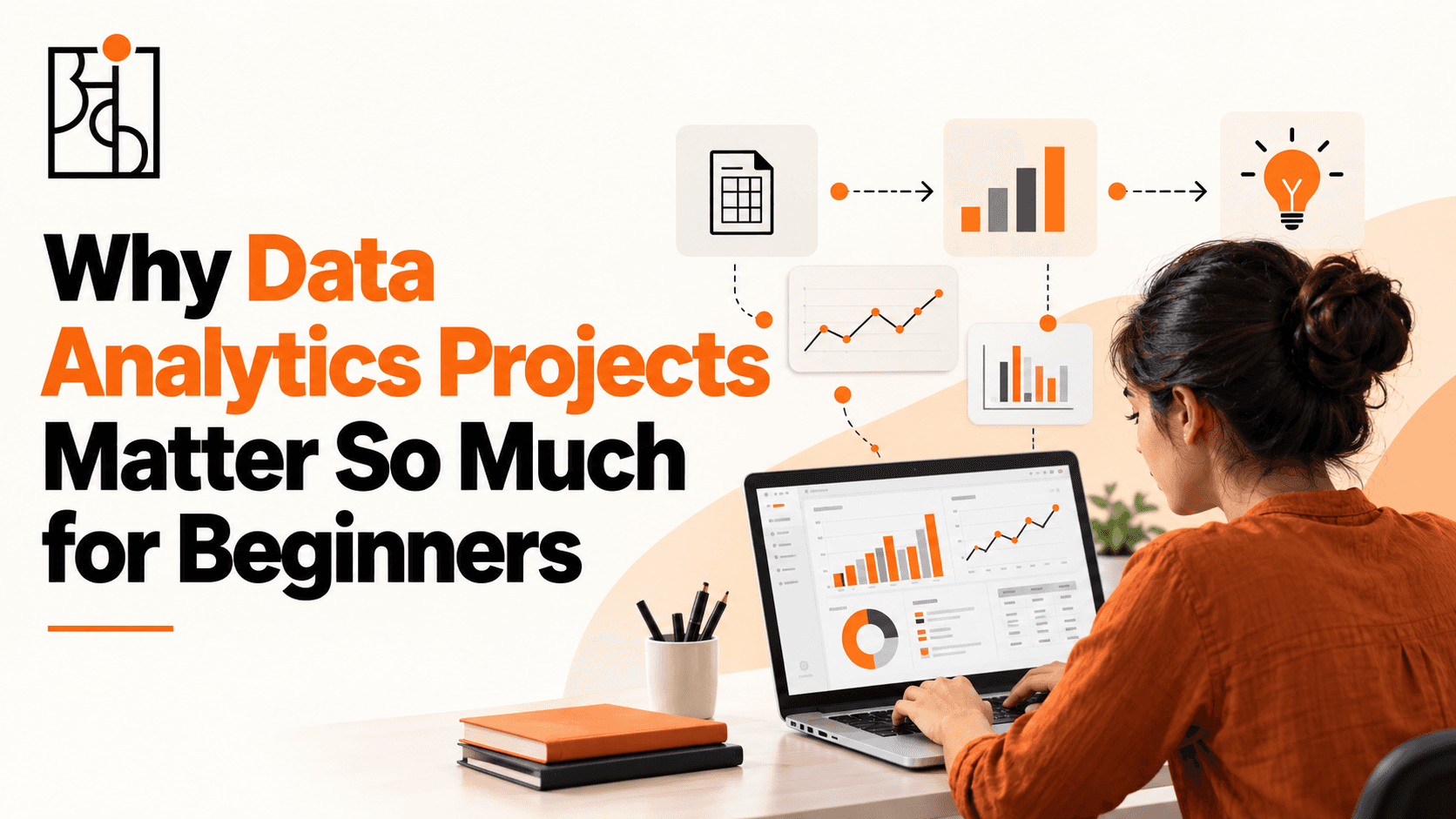
Data Analytics Projects for Beginners are essential for developing practical data analysis skills. While courses teach tools and concepts, real-world projects help beginners clean messy datasets, identify patterns, solve business problems, and build a portfolio that demonstrates their abilities to employers.
Knowing a tool and knowing what to do with it are two different things
Plenty of beginners can explain what VLOOKUP does. They can write a basic SQL query, define a p-value without blinking. Hand them a raw CSV file with zero instructions, though, and a lot of them freeze. That’s not really a knowledge gap. It’s an application gap, and most courses are built in a way that never forces anyone to actually close it.
A course gives you a clean, pre-built scenario with a known right answer sitting at the end, waiting patiently. A real project doesn’t do that for you. Nobody hands you the correct chart type. Nothing hints at which column actually matters. There’s no guarantee half the values aren’t missing or the formatting isn’t a mess. Working through that on your own — without a safety net — is what builds the skill employers actually care about. Not tool familiarity. Judgment.
Projects force the thinking tutorials quietly skip
Most tutorials follow the same comfortable shape: here’s the dataset, here’s the question, here’s the code, here’s the answer. That’s fine for learning syntax. It’s almost useless for the part of the job that actually matters, which is figuring out what question is even worth asking in the first place.
Even a small project pushes someone through the full sequence a tutorial usually skips right past. What’s this dataset actually about? Is there a genuinely interesting question hiding somewhere in it? What does the mess need before any of it’s usable? Which chart or summary actually answers the question, instead of just looking impressive on a slide? Question, mess, analysis, conclusion — that’s the real job. And projects are pretty much the only format that makes someone practice all four parts together, instead of just the easy middle bit.
A real project beats another certificate
Here’s the blunt part. Certificates have gotten common enough that they barely set anyone apart anymore. A recruiter’s probably seen the same three or four certification names a dozen times already this month. A real project — something actually built, something that can be explained and walked through out loud — stands out in a completely different way.
Think about how this plays out in an interview. “I’m certified in data analytics” gets a polite nod and not much else. “I went through two years of my city’s weather data and found a pattern I genuinely didn’t expect — here’s how I got there” gets a follow-up question. And that follow-up question is exactly where someone who’s actually built something shines, while a certificate-only candidate tends to go quiet.
Projects expose the gaps a course never will
One of the more underrated things about real projects is how clearly they show where your own understanding is shakier than you assumed. You can finish an entire course start to finish without ever hitting a real blind spot, because every exercise was built to work smoothly. A project offers no such protection.
Trying to clean an actually messy dataset is often the first moment someone realizes they never really understood how a function handles missing values. Choosing the right chart for one specific comparison is often the first time someone notices they’ve just been defaulting to bar charts this whole time, without ever asking why. Those little moments of friction aren’t fun in the moment. But that’s genuinely where the learning happens — the kind that watching videos passively just doesn’t produce.
Read More: How to Improve Logical Thinking: A Practical Guide to Thinking Critically
Small still counts. Really.
A common trap beginners fall into is assuming a “real” project has to be big, original, or impressive before it’s worth the effort. It doesn’t. The value comes from actually going through the full cycle — question, data, analysis, conclusion — not from how flashy or novel the topic happens to be.
A small, personal project works just fine as a starting point. A few months of your own spending. Public data about something you’re genuinely curious about. A dataset tied to a hobby, or something local to your city. The size barely matters. Finishing it does.
What a genuinely useful first project looks like
A good beginner project tends to share a few things. It starts with a real, specific question — not something vague like “explore the data” and hope something interesting shows up. The dataset is messy enough that actual cleaning has to happen, not some pre-scrubbed file that never pushes back. It ends with a clear, explainable conclusion, not a pile of charts with no real point attached to any of them. And — this part matters more than people expect — you can explain, out loud, why you made the choices you made. Why that chart. Why that cleaning step. Why that comparison, specifically.
Being able to explain your own reasoning is usually what separates someone who followed a checklist from someone who actually understands what they built.
Read More: How to Improve Logical Thinking: A Practical Guide to Thinking Critically
Why this matters more for beginners specifically
Experienced analysts already have real work sitting behind them, quietly doing the same job a beginner’s first project has to do. Beginners don’t have that yet. Which is exactly why early projects carry so much weight — they’re often the first real evidence, to an employer and honestly to the beginner too, that the actual thinking skill is there. Not just the vocabulary around it.
This is a big part of why Ankashram leans so heavily on project-based learning rather than theory-first courses. Watching a video about cleaning data teaches a fraction of what actually cleaning a messy dataset does, running headfirst into the specific, annoying problems that only show up in real data — never in a tidy example. The goal was never another certificate sitting in a folder somewhere. It’s walking away with something real enough to put in front of an interviewer and genuinely defend.
Read More : Online vs Offline Data Analytics Course Which Is Actually Better?1
The bottom line
Courses teach the vocabulary. Projects teach the job itself. For a beginner, the fastest way to close the gap between “I’ve learned about data analytics” and “I can actually do data analytics” was never going to be more lectures. It’s picking one real question, even a small one, and working through the entire mess of actually answering it. That’s the one part no course can hand over secondhand — and it’s exactly where the real skill ends up sticking.
Read More: How to Think Like a Data Analyst (Even If You’ve Never Touched a Spreadsheet


Frequently Asked Questions
Q1.Why are data analytics projects especially important for beginners?
Courses teach tools and ideas in isolation. Projects force all of it together — a real question, messy data that needs cleaning, choosing the right analysis, and explaining a clear conclusion at the end. That combination is what actually builds job-ready skill, not just familiarity with a tool.
Q2.Do beginner projects need to use big, impressive datasets?
Not at all. A small personal project — your own spending, something you’re genuinely curious about — teaches just as much as a massive dataset would, as long as it’s taken through the full cycle of question, analysis, and conclusion.
Q3.How many projects does a beginner actually need for a portfolio?
Quality wins over quantity here, every time. Two or three well-explained projects, where you can actually talk through the reasoning behind each decision, carry more weight in interviews than a long list of shallow, half-finished ones.
Q4.What’s actually different between a tutorial exercise and a real project?
A tutorial hands you a clean dataset and a known right answer waiting at the end. A real project is genuinely ambiguous — messy data, no predetermined “correct” chart, and a question you have to define and defend yourself.
Q5.Can someone do a meaningful project without strong technical skills yet?
Yes, honestly — that’s often where the technical skills actually come from. Real data forces someone to learn exactly what they’re missing. Waiting around until skills feel “good enough” usually just delays the most useful part of the whole process.
Q6.How does Ankashram approach project-based learning for beginners?
Ankashram builds its training around real, hands-on project work instead of theory-first lectures, specifically because working through genuinely messy data teaches a kind of thinking that passive learning rarely builds on its own.