Data Analyst Interview Questions and How to Prepare

Devansh walked out of his first data analyst interview convinced he’d done well. He’d answered every SQL question correctly, written a clean query for the join exercise, and even caught a subtle bug the interviewer had planted in a sample dataset. He didn’t get the offer. The feedback, when he finally asked for it, was almost jarring in how simple it was: he’d answered every technical question perfectly and never once explained his reasoning out loud, which left the interviewer with a correct answer and zero insight into how he actually thought through a problem. Devansh had prepared for the exam. He hadn’t prepared for the interview.
Table of Contents
That distinction matters more than most candidates realize going in. A data analyst interview isn’t really testing whether you can produce a correct final answer — plenty of candidates can do that. It’s testing whether your thinking is visible, logical, and trustworthy enough that a hiring manager would feel comfortable handing you a real, ambiguous business question and trusting what comes back. Preparing well means practicing for that, specifically, not just drilling more SQL syntax.


What These Interviews Are Actually Testing
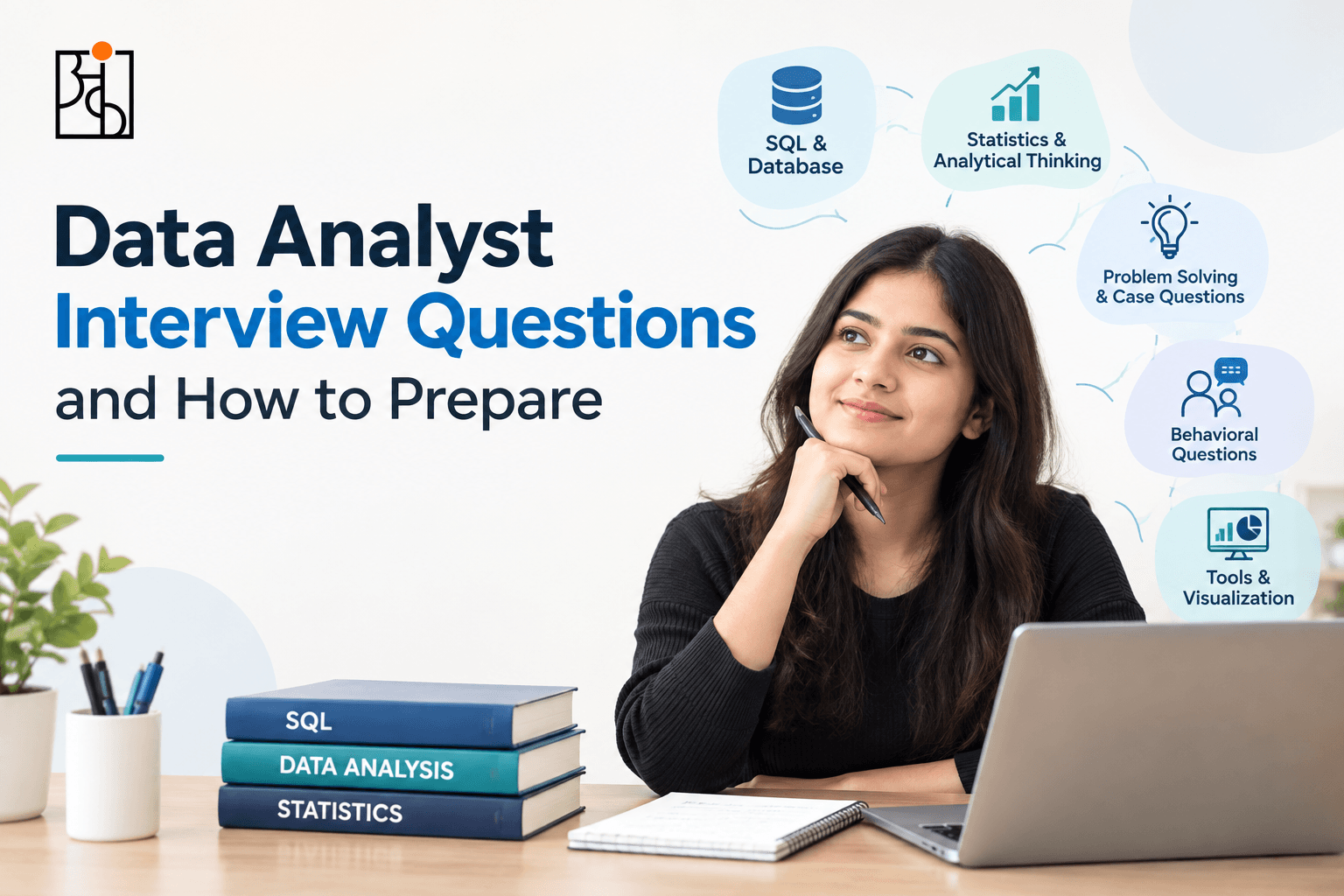
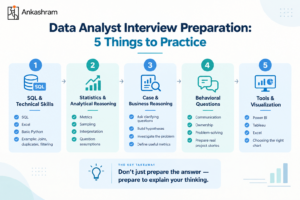
Most data analyst interviews run through some combination of five categories, and understanding what each one is genuinely trying to measure changes how you prepare for it. Technical skill — SQL, spreadsheets, sometimes Python — checks whether you can actually do the mechanical parts of the job. Statistical and analytical reasoning checks whether you understand what a number actually means, not just how to calculate it. Case or business reasoning questions check whether you can turn a vague, real-world question into something specific and answerable. Behavioral questions check how you’ve actually handled the messier, more human parts of past analytical work. And tool-specific questions confirm you’re not just theoretically capable but genuinely comfortable with whatever software the team actually uses day to day.
Most candidates over-prepare for the first category and badly under-prepare for the other four, which is exactly the gap that cost Devansh his first offer.
| Interview Area | What It Tests | What to Prepare | Example |
|---|---|---|---|
| SQL & Technical Skills | Ability to work with data and solve technical problems | SQL, Excel, basic Python | Joins, duplicates, filtering |
| Statistics & Analytical Reasoning | Ability to interpret numbers correctly | Averages, distributions, sampling, metrics | “Why did average order value increase?” |
| Case & Business Reasoning | Ability to structure ambiguous problems | Clarifying questions, hypotheses, metrics | “DAU dropped 10% — how would you investigate?” |
| Behavioral Questions | Communication, ownership and problem-solving | 2–3 real work/project stories | “Tell me about a time your analysis was wrong.” |
| Tools & Visualization | Practical familiarity with workplace tools | Power BI, Tableau, Excel, etc. | Choosing the right chart for a dataset |
Common SQL Interview Questions and How to Actually Prepare for Them
SQL questions in an interview rarely test obscure syntax — they test whether you can read a request, figure out what tables and joins it actually requires, and write something correct under mild time pressure. A typical question might ask you to find the second-highest value in a column without using a built-in function that makes it trivial, or to write a query joining three tables to answer something like “which customers placed an order in the last 30 days but haven’t reordered since.” Another common one: identify duplicate records in a table and explain how you’d handle them.
The preparation that actually helps here isn’t memorizing more functions. It’s practicing on genuinely messy, unfamiliar databases rather than the same clean sample database every tutorial uses, since real interview questions are deliberately built to feel unfamiliar. Equally important: narrate your thinking while you write the query, even in practice, so that habit is already built in by the time it matters in front of an interviewer. “I’m joining these two tables on customer ID because I need both the order date and the customer’s signup date to answer this” is a sentence worth saying out loud every single time you practice, until it stops feeling artificial.
It also helps to practice under a mild, artificial time constraint rather than always giving yourself unlimited time to think. Real interviews rarely hand over unlimited time for a technical question, and a candidate who’s only ever practiced without any pressure at all often experiences a real, disorienting jump in difficulty the first time a clock is actually running. Even a rough, self-imposed ten-minute limit during practice sessions closes a meaningful part of that gap before it costs you in an actual interview.
Read More : 10 Best Data Analytics Tools for Data Analysts in 2026: A Practical Guide
Common Statistics and Analytical Reasoning Questions
This category trips up candidates who’ve only studied statistics academically, since interview questions here rarely ask for a formula — they ask you to reason through a scenario. A common one: “If a coin comes up heads eight times in ten flips, what would you conclude?” The correct instinct isn’t to calculate anything immediately, it’s to say the sample size is too small to conclude much of anything yet, and explain why. Another frequent one: “A company’s average order value went up 20% last quarter — what questions would you ask before believing that’s a genuinely meaningful change?” A strong answer digs into what’s driving the average — a few outlier high-value orders skewing it, a change in product mix, an actual shift in typical customer behavior — rather than accepting the headline number at face value.
Preparing for this category means practicing skepticism as a habit, not memorizing definitions. Whenever you read a statistic anywhere — in the news, in a company report, anywhere — get in the habit of asking what would have to be true for that number to mean what it appears to mean, and whether the data actually supports that. This is a strange thing to practice deliberately, and it’s exactly the muscle these interview questions are testing.
Read More : Online vs Offline Data Analytics Course Which Is Actually Better?
Common Case and Business Reasoning Questions
Case questions are usually deliberately vague on purpose, and the vagueness is the actual test. “Our app’s daily active users dropped 10% last week — how would you investigate?” is a genuinely common prompt, and a candidate who immediately jumps to naming a specific cause has usually already lost points. The stronger response starts by asking clarifying questions: dropped compared to what baseline, across which user segment, starting exactly when, and did anything else — a product change, a marketing pause, a technical issue — happen around the same time. Only after narrowing the question down does a strong candidate start reasoning toward specific hypotheses worth checking.
A second common variant: “How would you measure whether a new feature is actually successful?” This tests whether a candidate can translate a vague goal (“successful”) into specific, measurable outcomes, and whether they think about both the intended positive effect and the possible negative side effects a feature might cause elsewhere in the product.
Preparing for this category benefits enormously from practicing with a real person rather than alone, since the back-and-forth clarifying questions are the actual skill being tested, and that’s hard to simulate solo. A study partner, a mentor, or even a structured mock interview service matters more here than in almost any other category on this list.
Common Behavioral Questions Specific to Data Roles
Generic behavioral questions (“tell me about a time you faced a challenge”) show up here too, but data-specific versions are worth preparing separately. “Tell me about a time your analysis was wrong, and how you found out” is a genuinely common one, and it’s testing something specific: whether you’re honest about mistakes and whether you have a real process for catching them, rather than presenting an unrealistic track record of never being wrong. “Describe a time you had to explain a technical finding to someone non-technical” tests communication ability directly, and a vague or generic answer here is one of the more common reasons a technically strong candidate still doesn’t get an offer.
“Tell me about a time a stakeholder disagreed with your analysis” is worth having a real, specific story ready for, since it tests both your technical confidence and your ability to handle disagreement professionally, without either caving immediately or getting defensive about a conclusion that might genuinely have a real flaw in it.
Preparing for this category means actually writing out two or three specific stories in advance, with real detail — not generic “I worked hard and it worked out” summaries, but a specific situation, a specific action you took, and a specific, honest outcome, including if the outcome wasn’t perfect.
Read More : Data Analyst Course: Syllabus, Roles and What It Actually Costs in 2026
Tool-Specific Questions
Depending on the role, expect direct questions about the specific tools the team actually uses — a Tableau or Power BI-focused role might ask you to describe how you’d visualize a particular kind of data, or ask about a time you had to choose between two different chart types for the same information and explain your reasoning. Excel-heavy roles might ask you to walk through how you’d solve a specific problem using pivot tables or a particular formula, sometimes live, sometimes just verbally.
The preparation here is fairly direct: if a job posting names specific tools, get genuinely comfortable with them beforehand rather than assuming general data skills will transfer smoothly in the moment. A candidate who’s clearly used Power BI for real projects, even small personal ones, comes across very differently from one who’s only watched a tutorial about it.
A Realistic Preparation Timeline
Two weeks before a specific interview, if that’s the timeline available, is enough time to prepare meaningfully, provided it’s spent deliberately rather than just rereading notes. The first several days should focus on SQL and technical practice using unfamiliar, genuinely messy datasets rather than the same clean one worked through repeatedly. The middle stretch is the right time to write out real behavioral stories in detail and practice case-style questions with another person, since these need rehearsal time to feel natural rather than scripted. The final few days before the actual interview are best spent on lighter review and specific research into the company and role itself — what does this specific business actually do, what metrics would plausibly matter to them, what recent news or changes might be relevant to a case question they ask.
Cramming purely technical practice into the final 48 hours before an interview, while skipping behavioral and case preparation entirely, is one of the most common and most avoidable mistakes candidates make under time pressure. It optimizes for the category most candidates already over-prepare for anyway.
| Time Before Interview | What to Focus On | What to Do |
|---|---|---|
| 10–14 days | SQL & technical skills | Practice unfamiliar datasets and timed SQL problems |
| 7–10 days | Statistics & analytical reasoning | Practice interpreting metrics and questioning assumptions |
| 5–7 days | Case questions | Practice business scenarios with a partner |
| 3–5 days | Behavioral questions | Prepare 2–3 specific project stories |
| 1–2 days | Company & role research | Review the job description, tools and business metrics |
| Final day | Light review | Review key concepts and avoid heavy cramming |
Mistakes That Show Up Repeatedly in Real Interviews
Silence while working through a technical problem is the single most common mistake, and it’s exactly what tripped up Devansh. An interviewer watching someone solve a SQL problem in complete silence has no way to evaluate the reasoning, only the final answer — and a wrong answer reached through clearly narrated, logical reasoning usually scores better than a correct one that arrived through an unexplained, silent guess.
Jumping straight to an answer on a case question, without asking any clarifying questions first, signals to an interviewer that a candidate might do the same thing on a real job — diving into analysis before actually understanding what’s being asked. This is an easy habit to fix with practice, and a genuinely common reason otherwise strong candidates underperform specifically on the case-question portion of an interview.
Overstating confidence in an uncertain answer is a subtler mistake that experienced interviewers catch quickly. Saying “I’m not fully certain, but based on X I’d guess Y, and here’s how I’d verify it” is a stronger answer than false confidence in a guess, since it demonstrates exactly the kind of honest, checkable reasoning the job actually requires day to day.
Read More : How Data Analytics Helps Businesses Think With Data
Reviewing Your Own Performance Honestly
Preparation doesn’t stop the moment an interview ends, and one habit separates candidates who improve quickly from candidates who keep making the same mistake across several interviews without noticing: writing down, immediately afterward while it’s still fresh, exactly which questions came up and how you actually answered them, not how you wish you’d answered them.
This matters specifically because interview anxiety distorts memory in a predictable way — most people remember their strongest moments clearly and quietly forget the exact wording of a moment where they froze or rambled. A written record, done honestly right after the interview, catches patterns that memory alone tends to smooth over. If the same category of question trips you up across two or three different interviews, that’s a specific, fixable signal worth acting on directly, rather than a vague sense that “interviews are just hard” that never quite turns into an actual improvement.
Requesting feedback afterward, even when it’s not always offered proactively, is worth doing more often than most candidates think to try. Some companies won’t provide detailed feedback for policy reasons, but plenty will if asked directly and politely, and even a short, general comment can reveal a blind spot a candidate would otherwise have no way of knowing existed on their own.
How Can Ankashram Help You Become a Data Analyst?
Preparing for interviews like these takes more than a list of sample questions — it takes actually practicing the reasoning behind them until it feels natural under real pressure, which is exactly where a lot of self-directed preparation quietly falls short. It’s one thing to read that interviewers want to hear your thinking out loud. It’s a different thing entirely to have practiced that habit enough times that it happens automatically in the room, instead of being a rule you’re consciously trying to remember mid-interview.
This is where Ankashram’s approach is built differently from a course that just lists what an interview covers. Rather than handing over a bank of questions and leaving the actual practice to chance, the training walks through why an interviewer asks a specific kind of question in the first place — what a case-style prompt is actually testing underneath the surface, why narrating your SQL logic out loud matters as much as the query itself, what a strong versus a weak answer to a behavioral question actually sounds like in practice. That’s the same “minute details, not just headlines” approach that runs through everything else Ankashram teaches, applied specifically to the moment that actually decides whether all your other preparation pays off.
For someone getting ready to walk into a real data analyst interview, that difference — understanding why each type of question exists, not just memorizing what to say in response to it — tends to be exactly what separates a candidate who freezes under an unfamiliar version of a familiar question from one who can actually reason through it live, the way Devansh eventually learned to, once he stopped treating interview prep as a second technical exam and started treating it as practice for making his thinking visible under pressure.
Bringing It Together
Devansh’s second interview, a few months later, went differently. Same technical difficulty, arguably a harder SQL problem than the one that tripped him up the first time — but this time he talked through every decision out loud, asked clarifying questions before diving into a case prompt, and admitted directly when he wasn’t fully sure about something rather than bluffing past it. He got that offer. The technical skill underneath both interviews had barely changed in the months between them. What changed was his understanding of what the interview was actually testing, and that understanding is the entire difference between preparing for an exam and preparing for a conversation someone’s actually trying to learn something real about you from.
Frequently Asked Questions
Q1.How technical do data analyst interviews actually get?
It varies by company and seniority level, but most entry-level interviews focus on practical SQL and spreadsheet skills rather than advanced statistics or machine learning. The technical bar tends to be “can you solve a real, moderately complex problem correctly,” not “do you know every edge case of an advanced technique.”
Q2.Should I memorize answers to common interview questions in advance?
Memorizing specific answers tends to backfire, since interviewers can usually tell when a response feels rehearsed rather than reasoned through live. Practicing the underlying skill — narrating SQL logic, asking clarifying questions on case prompts, structuring a behavioral story — transfers much better to an unfamiliar version of a question than a memorized script does.
Q3.What’s the best way to practice case and business reasoning questions specifically?
Practicing out loud with another person is considerably more effective than practicing alone, since the back-and-forth clarifying-question exchange is the actual skill being tested and it’s hard to simulate solo. A study partner, mentor, or structured mock interview setup all work well for this specific category.
Q4.How do I recover in an interview if I don’t know the answer to a technical question?
Say so honestly, and walk through how you’d actually find the answer rather than guessing blindly or freezing. “I don’t know this off the top of my head, but here’s how I’d look it up or figure it out” demonstrates a real, useful skill on its own, and most interviewers respond to that far better than a confident wrong answer.