Custom Corporate Training in Data

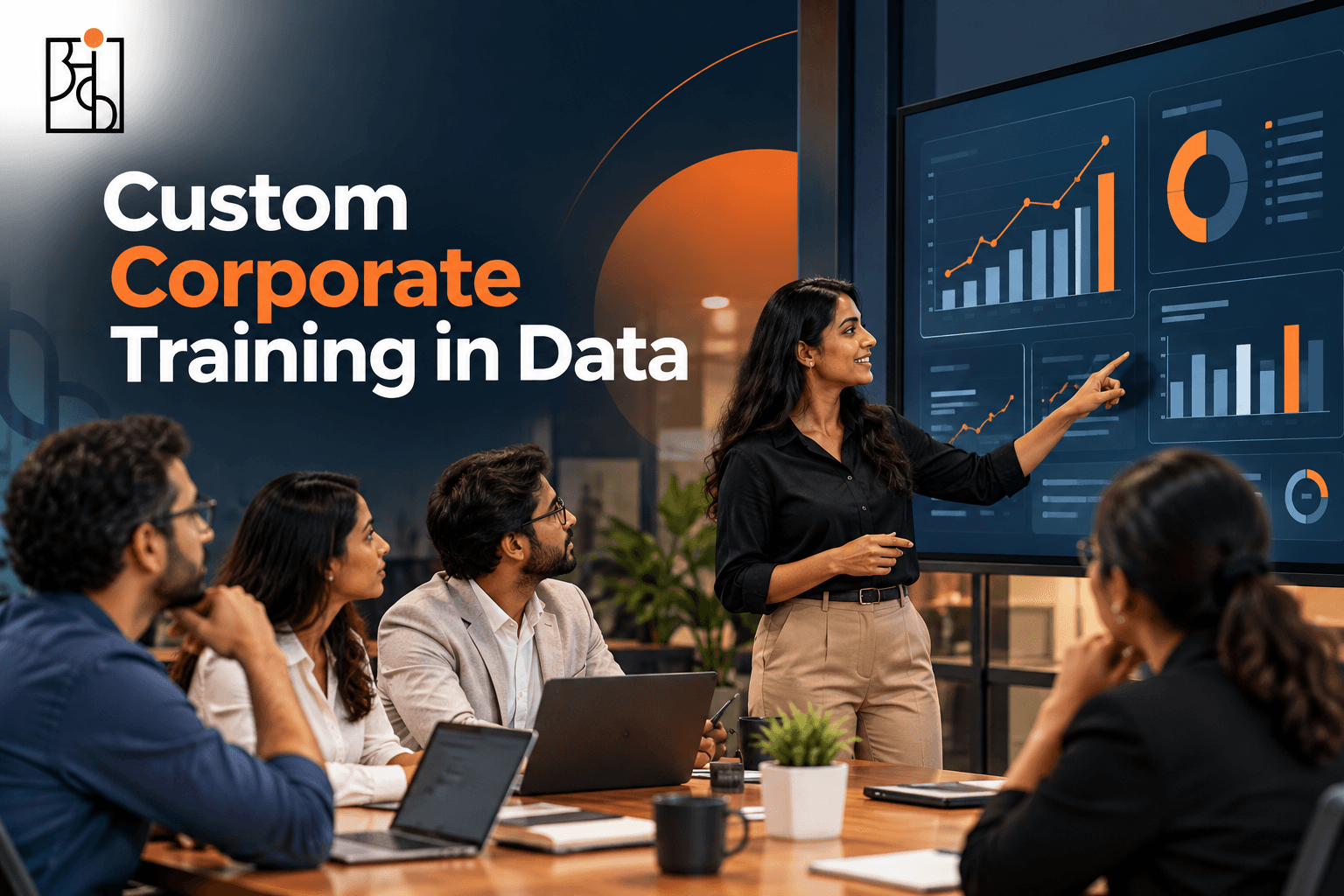
Custom corporate data training is built around a team’s own data, workflows and recurring problems, and that is exactly what most programs are missing. Most corporate data training looks the same. A generic slide deck gets built once, then rolled out to everyone: retail teams, finance people, plant operators, all with the same textbook definitions and the same two-hour talk on “what is data analytics.” People sit through it, nod politely, and go back to work the next day with almost nothing they can actually use.
Table of Contents


Why the Generic Stuff Doesn’t Work
Off-the-shelf training treats every company as if it’s interchangeable. A session written for a software firm gets lightly rebranded and delivered to a manufacturing plant. A few terms get swapped, but the examples, case studies, and exercises stay basically the same. Meanwhile, the real headaches a manufacturing team deals with — messy sensor readings, shift logs with inconsistent formats, feedstock numbers entered in the wrong units — look nothing like a software company’s data problems. Generic training rarely speaks to either one.
You end up with a room full of people who heard something technically correct and practically useless. They can repeat the phrase “data-driven decision making,” but they can’t name a single thing they’re going to do differently on Monday. Nothing in the session connected to the data sitting on their own desks.
What “Custom” Should Actually Mean
Real custom training isn’t a logo slapped onto the same old slides. It means building the session around the actual problems that particular team faces — real or realistic examples from their industry, their workflows, their known pain points — instead of convenient case studies that happen to be lying around. For an operations team, that might mean shift logs, sensor readings, and the unit mismatches that quietly throw a dashboard off overnight. For an HR team, it might be how one blank field can silently stop an automated performance review from ever starting. For a retail or FMCG team, it might dig into product master data — the kind of inconsistency that’s already caused well-documented write-downs running into the billions at major retailers expanding into new markets.
The specific example changes. The underlying skill stays the same: catching a data problem at the source, before it has a chance to ripple into a dashboard, a target, or a decision. Custom training earns the name by making that skill land for the people in the room, using problems they’d actually recognize.
Real Experience, Not a Script
One of the biggest differences between useful training and a rehearsed performance is whether the person leading it has actually lived the problems being discussed. A facilitator who’s spent more than a decade working across retail, CPG, food and beverage, and high-end manufacturing brings something a generic trainer reading from slides can’t: the ability to answer a question that wasn’t in the script, because they’ve probably seen a version of it before. People in the room can tell within the first ten minutes. They know whether the facilitator genuinely understands their world or is just delivering prepared material. You feel it in the answers — specific and real, or vague enough to apply to any industry.
Make It Interactive, Not Another Lecture
Corporate training has a reputation for being passive for a reason: people watching slides scroll by, nodding occasionally, checked out by the halfway mark. The alternative isn’t complicated. It just requires designing for participation instead of pure delivery. A quick live poll at the start — asking people to honestly assess their own role, then revealing that almost everyone is already analyzing information for a living — grabs attention faster than ten minutes of definitions. A hands-on exercise works even better: hand the team a realistic, deliberately messy data log and ask them to find every problem hiding in it before it would sync into a live system. People remember what they caught themselves far longer than what they were told.
Structure it as poll → concept → real example → hands-on exercise → debrief, and the session stops being something people sit through and becomes something they actually take part in. That’s usually the difference between a session that changes behavior and one that’s forgotten by lunch.
Match the Examples to the Room
A proper custom session adapts its examples to who’s actually there. A bio-process or plant operations team gets more out of feedstock entries, digester readings, and scaling errors that make a dashboard flag a false alarm overnight. A retail or CPG team benefits more from product master data examples and the kind of inconsistency that slowly erodes confidence in the company’s own numbers.
This isn’t just cosmetic. A plant operations team doesn’t need a long case study about retail product data to understand why source data sanity matters. They need an example close enough to their actual job that the lesson transfers immediately — without anyone having to translate it in their head.
What Good Training Actually Leaves Behind
The real test isn’t whether people enjoyed the hour. It’s whether anything changes afterward. Good custom data training should leave a team with a small number of concrete habits — not a long list of abstract principles that fade by the end of the week.
That might look like four specific habits for source data sanity: putting the unit clearly in every field name, agreeing on realistic bounds for every parameter, standardizing formats so small variations don’t quietly split a dataset, and assigning clear ownership for who checks and maintains each field. None of that requires new software. It requires people who’ve internalized why it matters, because the session connected the idea to something they recognized from their own work.
Why This Matters More Right Now
Data volumes keep growing, and more of that data is feeding straight into automated systems — dashboards, AI summaries, workflows — with less human review sitting between the entry point and the decision. That makes the habits formed at the moment of entry more important than they used to be. There’s less of a safety net catching mistakes before they spread.
At the same time, generic “learn data analytics” training has become completely commoditized — widely available, cheap, and mostly interchangeable. For organizations that are serious about building a real data culture, the differentiator isn’t access to training. It’s training built around their own people, their own workflows, and their own recurring mistakes.
That’s the gap Ankashram’s corporate training is designed to close. Not a generic course with a few industry terms swapped in, but sessions built around a specific team’s actual data, actual industry, and actual failure points — delivered by facilitators who’ve genuinely worked the kinds of problems being discussed. The goal isn’t a pleasant afternoon away from the desk. It’s a team that walks out with habits they’ll still be using a month later.
Frequently Asked Questions
Q1 How is custom corporate training different from a standard data analytics course?
A standard course is built once and delivered the same way to every audience. Custom training is built around a specific team’s actual data, workflows, and recurring problems, using examples people will recognize from their own work.
Q2.Does custom training require participants to have a technical or data background?
No. Good custom training starts from where people actually are — often people who don’t think of themselves as “data people” at all — and builds the habit of thinking clearly with data from there.
Q3.What industries can custom data training be built for?
Almost any. The underlying skill — catching bad data at the source before it spreads — applies everywhere. The examples simply shift to match the audience: operations, HR, retail, manufacturing, or whatever function is in the room.
Q4.How long does a typical custom training session run?
It varies, but focused sessions are often designed for under an hour or two — short conceptual framing plus hands-on, interactive exercises rather than a long lecture.
Q5.What should a team expect to walk away with?
Specific, practical habits they can start using right away — for example, clear rules around unit labeling, valid data ranges, format consistency, and field ownership — not just a vague sense that “data quality matters.”
Q6.Why does the facilitator’s background matter?
Someone with real multi-industry experience can answer unscripted questions that are specific to the audience’s situation, instead of falling back on prepared material. That difference is often what separates a session people actually engage with from one they quietly sit through.